Cambridge Primary Science · Stage 4 · Earth and Space

The
Atmosphere

A blanket of gases wrapped all the way around the Earth. It is where every cloud forms, every bird flies and every breath you take comes from.

5 layers
0–10,000 km thick
78% nitrogen
100 km to space
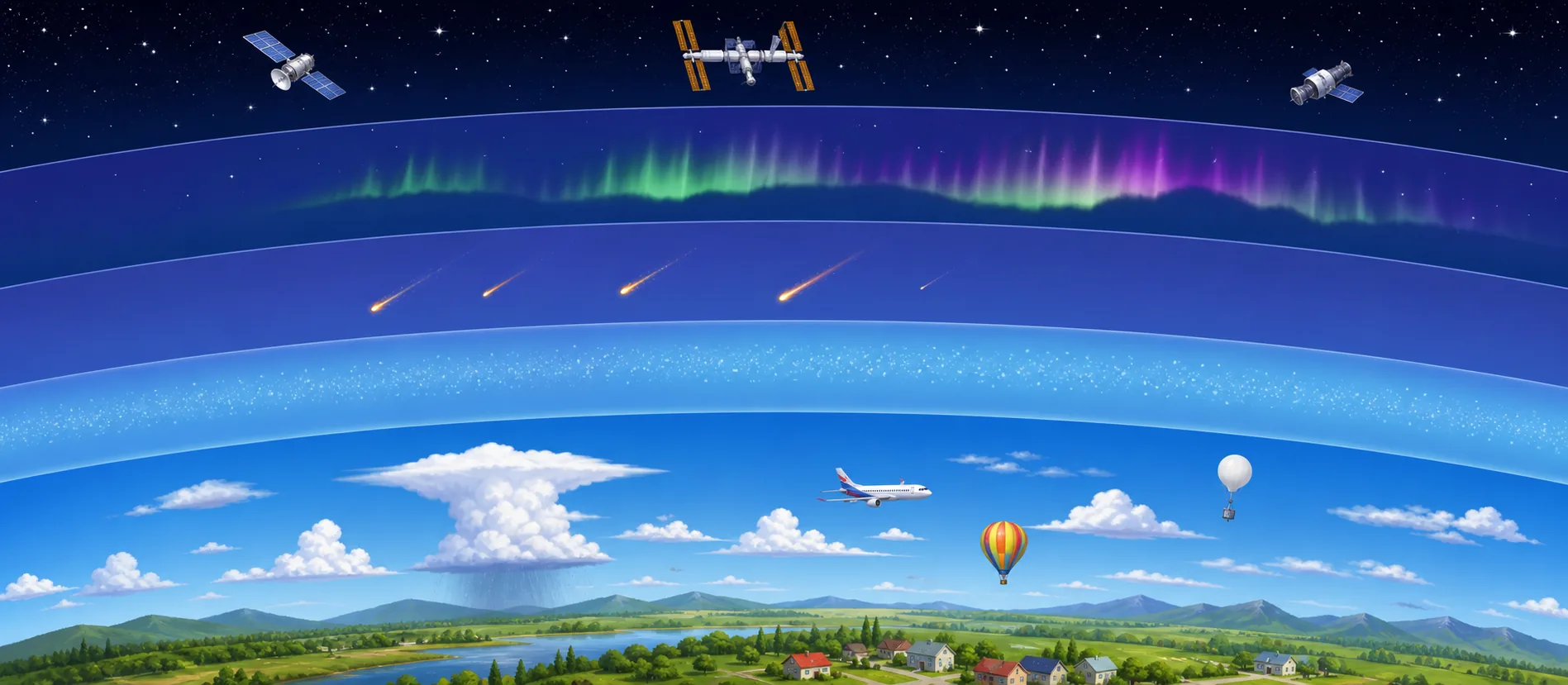
Earth's atmosphere shown in wide layers with clouds, aircraft, meteors, auroras, a space station and satellites.
Cross-section of Earth's atmosphere: green hills, a village and trees at the bottom, clouds and an aeroplane in the troposphere, a weather balloon rising past the ozone layer in the stratosphere, two meteors burning up in the mesosphere, aurora ribbons and a space station in the thermosphere, and a satellite among stars in the exosphere.

Start here

What is the atmosphere?

Hold out your hand. It looks like there is nothing there — but there is. Air is all around you, and air is a real material. It takes up space, it has mass, and you can feel it push against you when you run or when the wind blows.

The atmosphere is the huge layer of air that wraps around the whole Earth. Gravity holds it in place, the same way gravity holds you on the ground. Without gravity, the air would simply drift away into space.

The atmosphere is not the same all the way up. As you climb higher the air gets thinner — the gas particles spread further apart, so there is less air to breathe. Scientists divide the atmosphere into five layers, and each layer behaves in its own way.

Figure 1

The five layers

Read this chart from the bottom up — that is the direction you would travel. Point at any layer to light it up.

Not to scale — the vertical scale is broken between layers
10,000km

Exosphere

about 600 km → 10,000 km · the outer edge

The last, thinnest layer. The air here is so spread out that particles almost never bump into each other, and some drift off into space for ever. There is no wall and no line — the atmosphere simply fades away.

  • Weather satellites orbit here
  • Fades into space
600km

Thermosphere

85 km → 600 km · over 1,500 °C — but you would still feel freezing

The hottest layer by temperature, because the few particles up here absorb strong energy from the Sun. But there are so few of them that they could hardly warm you at all. This is where the beautiful auroras glow.

  • Space Station orbits at ~400 km
  • Edge of space at 100 km
  • Auroras
85km

Mesosphere

50 km → 85 km · the coldest place on Earth, about −90 °C

This layer is Earth's shield. Millions of small rocks from space race towards us every day, and nearly all of them burn up here because of the friction with the air. We see the streaks of light and call them shooting stars.

  • Meteors burn up
  • Coldest layer −90 °C
50km

Stratosphere

12 km → 50 km · gets warmer as you go up

Dry, calm and almost cloud-free. It holds the ozone layer (about 15–35 km up), a thin band of gas that soaks up the Sun's harmful ultraviolet rays before they reach us. Weather balloons climb up into this layer, then burst.

  • Ozone layer 15–35 km
  • Weather balloons reach ~35 km
12km

Troposphere

ground level → about 12 km · gets colder as you go up

You live here, and so does all of the weather. Rain, snow, wind, thunder and nearly every cloud happen inside this bottom layer. It is the thinnest layer of the five, yet it holds about three quarters of all the air in the atmosphere, because gravity squashes the air down towards the ground.

  • Mount Everest 8,848 m
  • Aeroplanes cruise at 10–12 km
  • ~75% of all the air
  • All weather

Now the honest picture

Figure 1 has to stretch the layers so you can read them. Here is the same troposphere drawn at its true size against the Earth — every cloud, every storm and every aeroplane that has ever flown fits inside that thin orange line.

SPACE STATION — 400 KM UP AGREED EDGE OF SPACE (KÁRMÁN LINE) — 100 KM UP THE WHOLE TROPOSPHERE — 12 KM EARTH — 6,371 KM TO THE CENTRE

Try this size comparison. If the Earth shrank to the size of a football, the whole troposphere would be a skin about 0.2 mm thick — about two sheets of paper. That is all the air we have.

Figure 2

What is air made of?

Air is not one gas — it is a mixture. Imagine you could catch exactly 100 tiny pieces of dry air in a jar. Count what you would find.

1 square = 1 piece in every 100

  • 78% NitrogenThe gas that fills most of the sky. Our bodies cannot use it directly — we simply breathe it back out.
  • 21% OxygenRoughly 1 piece in every 5. This is the gas that keeps animals alive and lets things burn.
  • 1% Everything elseMostly argon. Carbon dioxide is only about 0.04% — four hundredths of one square — yet plants could not live without it.
Table 1 — the gases in dry air, by volume
GasShare of the airIn 100 pieces
Nitrogen78.08%78 pieces
Oxygen20.95%21 pieces
Argon0.93%1 piece
Carbon dioxide0.04%far less than 1
Neon, helium, methane and otherstracesfar less than 1

Where is the water? Real air also carries water vapour — water as an invisible gas. It changes from almost none on a dry day to about 4 pieces in 100 in a hot, damp place, so scientists measure it separately from the gases above.

Why it matters

Six jobs the atmosphere does

01

Air to breathe

Every animal on Earth takes oxygen out of the air, and every plant takes carbon dioxide. No atmosphere, no life.

02

A warm blanket

Gases in the air trap some of the Sun's heat. Without them Earth's average temperature would be about −18 °C instead of a comfortable 15 °C.

03

A sun shield

The ozone layer high in the stratosphere absorbs the Sun's harmful ultraviolet rays — the ones that would burn skin and damage plants.

04

A meteor shield

Rocks from space hit the air at enormous speed and burn away in the mesosphere long before they can reach the ground.

05

Weather and water

The water cycle runs inside the troposphere. Water evaporates, rises, cools, condenses into clouds and falls again as rain or snow.

06

It carries sound

Sound needs a material to travel through, and air is that material. In space there is almost no air — so space is completely silent.

Thinking and working scientifically

Investigate: is air really there?

Predict first, then test. Before you start each investigation, write down what you think will happen and why. Comparing your prediction with what really happens is what scientists do.

1. Air takes up space

You need: a clear plastic cup · a paper towel · a deep bowl of water

  1. Scrunch the paper towel and push it firmly into the bottom of the cup so it cannot fall out.
  2. Predict: will the paper get wet?
  3. Turn the cup upside down and push it straight down into the water until it is completely under.
  4. Lift it straight back out and feel the paper.
  5. Now do it again, but tip the cup sideways under the water and watch carefully.

What happens: the paper stays dry. Air is trapped inside the cup, and the water cannot get in because the air is already taking up that space. When you tip the cup, you see the air escape as bubbles — and only then does the water rush in and soak the paper.

2. Air has mass

You need: 2 identical balloons · a ruler or stick · string · a pencil

  1. Tie a balloon to each end of the ruler, then hang the ruler from its middle so it balances level.
  2. Predict: what will happen if one balloon is blown up?
  3. Take one balloon off, blow it up, tie it and put it back in exactly the same place.
  4. Let go and watch which way the ruler tips.

What happens: the side with the inflated balloon dips down. The only thing you added was air — so air has mass. It is a real material, just like water or wood, even though you cannot see it.

Check what you know

Six questions

Q1Which gas makes up most of the air?

Nitrogen — about 78%, or roughly 4 pieces in every 5. Many people guess oxygen, but oxygen is only about 21%.

Q2In which layer does all of our weather happen?

The troposphere — the bottom layer, from the ground up to about 12 km. It holds about three quarters of all the air and nearly all the water vapour.

Q3Which layer is the coldest, and which is the hottest?

Coldest: the mesosphere, about −90 °C. Hottest: the thermosphere, over 1,500 °C — but the air there is so thin that an astronaut would still feel freezing cold.

Q4Where do shooting stars come from?

They are small rocks from space, called meteors, burning up as they rub against the air in the mesosphere. The atmosphere destroys them before they can reach the ground.

Q5What does the ozone layer do, and where is it?

It absorbs the Sun's harmful ultraviolet rays. It sits in the stratosphere, roughly 15–35 km above the ground.

Q6Does the atmosphere have a sharp edge where space begins?

No. The air just gets thinner and thinner and fades away. Scientists agreed to call 100 km the edge of space so that everyone measures the same way — but there is no wall there, and a little air carries on for thousands of kilometres.

Keep going

Practise and play

Word bank

Twelve words to know

atmosphere
The layer of gases held around the Earth by gravity.
gas
A material that spreads out to fill whatever space it is in. Air is a mixture of gases.
mixture
Two or more materials together that are not joined to each other.
nitrogen
The gas that makes up about 78% of the air.
oxygen
The gas animals need to breathe, about 21% of the air.
carbon dioxide
A gas plants take in to make food. Only about 0.04% of the air.
water vapour
Water in the air as an invisible gas.
ozone
A gas in the stratosphere that blocks the Sun's harmful rays.
altitude
How high something is above the ground or sea level.
air pressure
The push of the air. It gets weaker the higher you go.
meteor
A rock from space that burns up in the atmosphere, seen as a shooting star.
aurora
Coloured lights in the sky near the poles, made high in the thermosphere.
For the teacher

Planning notes

Learning objectives

By the end of the lesson, learners can:

  • Describe the atmosphere as a layer of gases held around the Earth by gravity.
  • Name the five layers in order and say one thing that happens in each.
  • State that air is a mixture, mostly nitrogen with about a fifth oxygen.
  • Explain that the atmosphere gets thinner with altitude and has no sharp edge.
  • Give evidence from an investigation that air is matter — it takes up space and has mass.
  • Describe at least three ways the atmosphere protects and supports life.

Misconceptions to watch for

  • “Air is nothing.” Investigation 1 and 2 are the direct evidence — run them before the diagram, not after.
  • “Air is mostly oxygen.” Very common. The 100-square grid in Figure 2 fixes it faster than the percentages do.
  • “The atmosphere stops at a line.” The 100 km boundary is an agreement between scientists, not a wall.
  • “The thermosphere is hot, so it would feel hot.” Temperature measures how fast particles move; heat you feel depends on how many there are.
  • Diagram scale. Figure 1 must stretch the layers to be readable. Always pair it with the true-scale drawing so learners do not build a wrong mental picture.

Curriculum fit: Earth and Space, with Thinking and Working Scientifically covered through predicting, observing and explaining in the two investigations. Objective reference codes differ between framework versions — map the objectives above to the codes in your current Cambridge Primary Science framework before you plan the lesson.